
No. Pricing evidence is one input. FlipForge is designed to validate exact identity, classify evidence quality, evaluate economics, confidence, liquidity, grading context, and risk, then explain the resulting decision state.
Frequently Asked Questions
What FlipForge does, what it does not do, and what the beta is actually testing.
Clear boundaries matter when money, grading fees, and uncertain market evidence are involved.
QUESTIONS WORTH ASKINGWhat counts?
What counts?
What can I trust?
Explore the practical limits around card identity, market observations, grading assumptions and Private Beta access.
SEE HOW DECISIONS WORK01 / THE CARDAM I COMPARING THE RIGHT ONE?→
02 / THE EVIDENCEWHAT SHOULD ACTUALLY COUNT?→
03 / THE DECISIONWHEN SHOULD I WAIT OR PASS?→
04 / THE BETAWHO CAN GET ACCESS?→
THE SHORT VERSION
Questions, answered clearly.
The fastest way to understand FlipForge is to see the sequence: identify the card, filter the evidence, resolve the decision, and keep the reason visible.
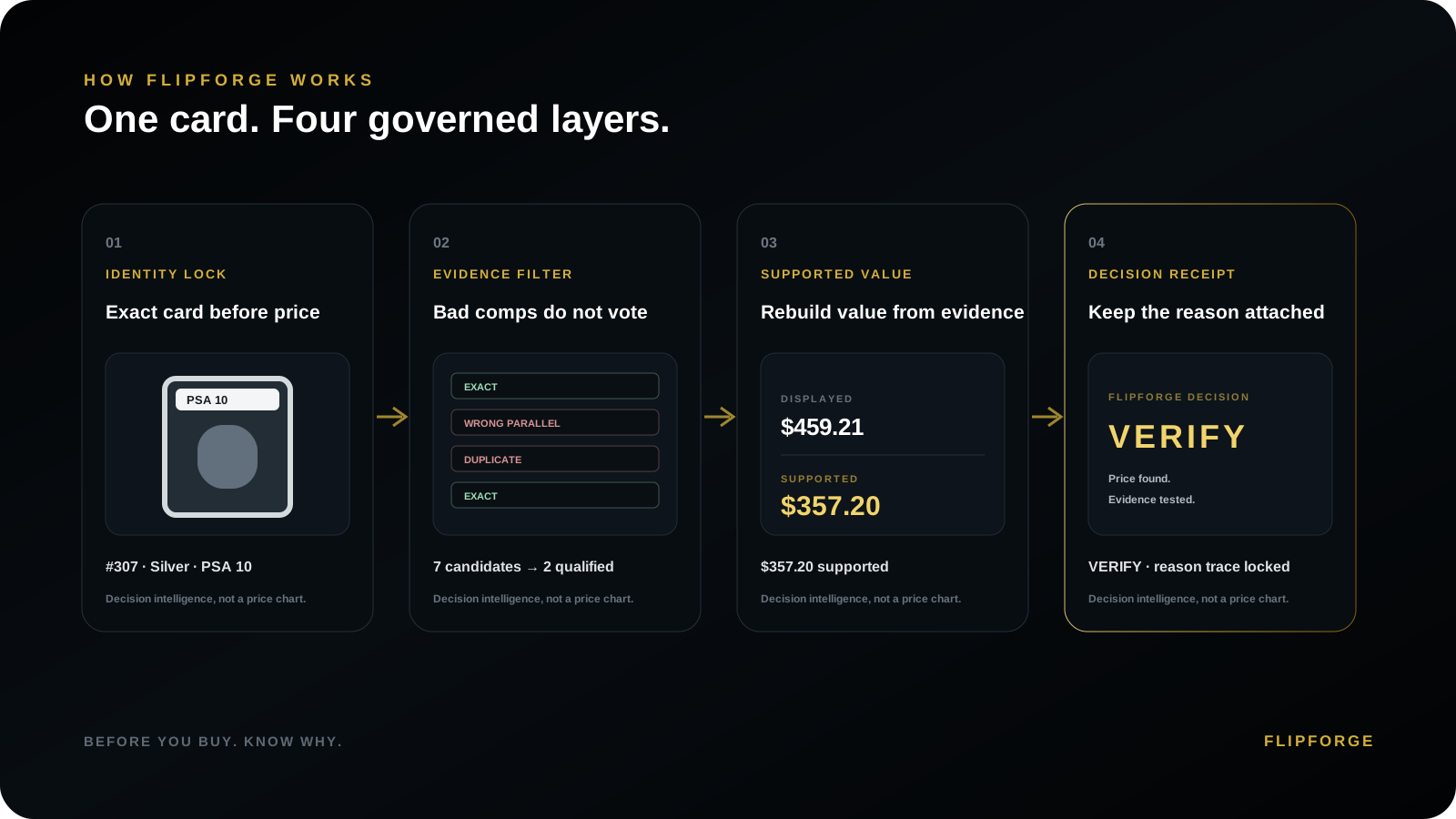
Short version: FlipForge is an authenticated web-based card-intelligence workspace. It is not a marketplace, not an auto-buy tool, and not a guarantee of price, grade, or profit.
Baseball, football, basketball and hockey cards (MLB, NFL, NBA and NHL). FlipForge matches the exact card first: year, set, card number and parallel, and for a graded card the grading company and grade.
Graded cards from the major graders, including PSA, BGS, SGC and CGC, are compared with sales of the same card at the same grader and grade. Sales that name a different grader or grade, or that are marked raw, are set aside. Non-sport cards such as Pokémon are not covered yet. When there isn’t enough evidence for a card, FlipForge says VERIFY instead of guessing.
FlipForge uses four decision-support states: BUY, WATCH, VERIFY, and PASS. BUY means the saved evidence supports the purchase at the evaluated price, within the stated risks and limits. It is still decision support—not transaction authority—and it does not guarantee a return.
BUY means the saved evidence supports the purchase at the evaluated price within the stated risks and limits. WATCH means there may be an opportunity, but the price or evidence is not strong enough yet. VERIFY means there is not enough matching evidence yet to make the purchase confidently. PASS means the current evidence does not justify the purchase at the evaluated price.
FlipForge uses authorized sources and appropriately labeled evidence to support sports-card decisions. These may include third-party data providers, marketplace information, independent auction records, and user-entered evidence.
A reported completed sale is not automatically proof that payment settled. FlipForge evaluates card identity, available transaction details, evidence quality, and limitations before using a record to support a decision.
Provider-backed completed-sale evidence is currently suspended in the Private Beta. When suitable evidence is unavailable, FlipForge must communicate that limitation rather than manufacture confidence.
No. No software can guarantee a future grade. Grading analysis should make the grade probabilities, grading costs, raw value, downside, and break-even assumptions visible before a submission decision.
No. The customer private beta is an authenticated web experience. Testers need a modern browser and reliable internet access. Internal owner/operator tooling may use separate environments, but customers should evaluate the hosted product.
The hosted product stores account-scoped product records needed for saved evaluations, tracking, evidence, usage, and related workflows. Beta application information is handled separately for access, onboarding, support, and product communication. See the Data Use and Privacy pages for the governing disclosures.
Final package pricing has not been published. Scout, Collector, and Pro currently describe the planned product structure, not active paid offers. Commercial terms will be set only after beta evidence, feature depth, operating costs, and customer value have been reviewed.
No. Paid checkout is not active during the current private beta. Requesting or receiving beta access does not create a paid subscription. Any future checkout must be a separate explicit customer action after commercial launch review.
Forge Heat is being tested as an interactive beta intelligence layer over saved, evidence-qualified evaluations. It is not being sold as a finished paid entitlement today. Pro is the intended future commercial home if the feature clears validation.
No. The product policy is to avoid unauthorized scraping and fabricated sold data. Marketplace or provider data should come through authorized or approved access paths.
Yes. Decision details preserve the reason trail: target identity, evidence included or excluded, warnings, assumptions, confidence, risk, and the factors behind the saved outcome. The point is to make the decision inspectable later, not just display a score.
Saved decisions can be reviewed at Days 7, 14 and 30. Outcomes are recorded only when the original Day-0 baseline and sufficient permitted follow-up evidence are available. The goal is to compare the original reasoning with later market/evidence conditions and build calibration from governed outcomes rather than publish an invented accuracy number.
Want to see the reasoning instead of reading about it?
Use the homepage demo, open the Evidence Lab, or review a complete sample Decision Dossier before applying for beta access.